
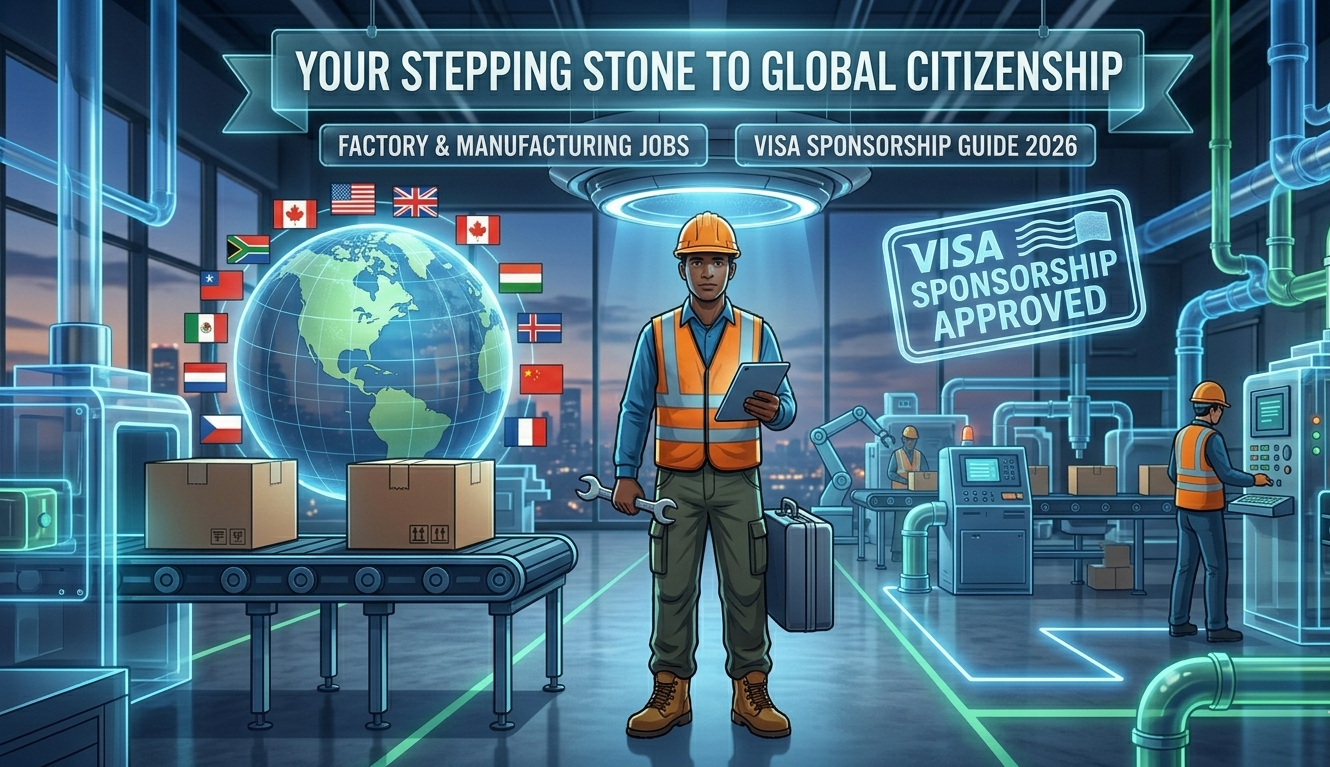
Are you looking for a legitimate, high-paying way to move abroad, but feeling overwhelmed by strict degree requirements or complex immigration points systems?
You are not alone. Millions of aspiring expats face the same roadblock every year. But here is the secret the corporate world doesn’t tell you: Factory and manufacturing jobs are currently one of the fastest, most reliable tickets to securing a visa sponsorship abroad.
Due to massive, ongoing labor shortages across North America and Europe, international factories are looking beyond their borders to recruit hard-working individuals. The best part? Many of these roles require zero previous experience. Whether you want to pack goods, operate machinery, or work in food production, factory work can be your ultimate “foot in the door” to global citizenship, stable income, and permanent residency.
In this comprehensive 2026 guide, we will break down exactly how to find these jobs, what you can expect to earn, the exact visas you need, and how to protect yourself from scams. Let’s dive in!
Why Factory Workers Are in Such High Demand Right Now
It’s simple math: the world’s biggest economies are expanding, but their workforces are shrinking. Manufacturing sectors in developed countries are facing a “perfect storm”:
-
An Aging Population: Older workers are retiring faster than younger generations can replace them.
-
A Shift in Career Choices: Local citizens are increasingly favoring remote office work, leaving physical industries with massive staffing gaps.
-
Booming Consumer Demand: From the food we eat to the cars we drive, global demand is at an all-time high.
Because factories cannot afford to let production lines stop, governments have created special immigration pathways allowing employers to sponsor international workers.
What Does “Visa Sponsorship” Actually Mean?
When a job post says “Visa Sponsorship Available,” it means a licensed employer is willing to act as your legal guarantor to the government. Depending on the country, an employer-sponsored package often includes:
-
Work Permit Support: Filing the government paperwork required to legalize your employment.
-
Job Offer Documentation: Providing a formalized contract (like an LMIA in Canada) required for your visa interview.
-
Relocation Assistance: Some top-tier companies will even help cover your flight, arrange your initial housing, or provide a relocation allowance.
Top 6 Factory Roles Open to International Workers
If you are entering this industry for the first time, you don’t need an engineering degree. Here are the most common positions factories recruit for globally:
1. Production Worker / Line Assembly
-
The Job: You are the heartbeat of the factory floor. You’ll assemble products, monitor production lines, and perform quick quality checks.
-
Why it’s great: Excellent entry-level position with plenty of opportunities for overtime pay.
2. Factory Packer
-
The Job: Once products are made, they need to be packed safely. You will sort, label, and pack items into boxes for shipping.
-
Why it’s great: This role has virtually zero barrier to entry and requires very little English or local language fluency to start.
3. Food Processing Worker
-
The Job: Working in meat-processing plants, bakeries, or canned goods facilities. Duties include sorting ingredients, operating packaging machines, and maintaining strict hygiene standards.
-
Why it’s great: Food security is a government priority everywhere. Because of this, food processing jobs often have the highest volume of visa sponsorships available.
4. Machine Operator
-
The Job: Setting up, controlling, and maintaining heavy manufacturing equipment (like mixers, presses, or CNC machines).
-
Why it’s great: If you have some technical skill or are willing to learn, machine operators command much higher hourly wages.
5. Warehouse & Logistics Associate
-
The Job: Loading and unloading delivery trucks, driving forklifts, and managing inventory.
-
Why it’s great: A perfect transition role if you prefer moving around a warehouse rather than standing in one spot on an assembly line.
6. Quality Control Inspector
-
The Job: Examining finished goods to ensure they meet safety and design standards before being shipped to customers.
-
Why it’s great: Less physically demanding, requiring high attention to detail rather than heavy lifting.
Where Should You Move? Global Salary & Visa Breakdown
Let’s look at the actual numbers and legal pathways for the top destinations in 2026.
🇨🇦 CANADA: The Land of Long-Term Permanent Residency
Canada remains the gold standard for international workers because its work permits frequently lead to Permanent Residency (PR).
-
Average Salary: CAD $16 to $30 per hour (CAD $35,000 – $65,000 / year)
-
High-Demand Provinces: Ontario, Alberta, Manitoba, Saskatchewan, and Nova Scotia.
-
The Visa Pathways:
-
TFWP (Temporary Foreign Worker Program): Requires the employer to get a positive Labour Market Impact Assessment (LMIA) proving they couldn’t find a local Canadian.
-
AIP (Atlantic Immigration Program): A brilliant, fast-track pathway for jobs in Canada’s eastern coastal provinces.
-
PNPs (Provincial Nominee Programs): Specific provinces invite semi-skilled workers directly based on regional labor shortages.
-
🇬🇧 UNITED KINGDOM: Quick Entry for High-Demand Sectors
Post-Brexit, the UK relies heavily on international talent to keep its supply chains moving, particularly in the food sector.
-
Average Salary: £22,000 to £38,000 per year
-
Top Industries: Agri-food manufacturing, logistics hubs, and pharmaceutical packaging.
-
The Visa Pathways:
-
Skilled Worker Visa: If the factory role meets the government’s minimum skill and salary threshold.
-
Short-Term Seasonal Worker Visa: Often used for food processing and agriculture, allowing you to work for up to 6 months at a time.
-
🇺🇸 UNITED STATES: The High-Wage Powerhouse
While US immigration is highly competitive, its massive manufacturing economy offers some of the highest earning potentials in the world.
-
Average Salary: USD $15 to $35 per hour (USD $35,000 – $75,000 / year)
-
Top Industries: Automotive (Midwest states like Michigan and Ohio), electronics, and commercial food production.
-
The Visa Pathways:
-
H-2B Visa: A temporary visa for non-agricultural seasonal workers. Essential for factories with peak production seasons.
-
EB-3 Visa (Unskilled Category): A highly coveted green card pathway for employers who can prove a chronic, permanent shortage of local workers.
-
🇪🇺 EUROPE: Rich Culture and Great Work-Life Balance
Several European nations have revamped their immigration laws to make it easier for international workers to move.
-
Germany (€30,000 – €55,000/year): Focuses heavily on automotive and heavy industrial machinery. Look into the Opportunity Card (Chancenkarte) points system.
-
The Netherlands (€25,000 – €45,000/year): High demand for warehouse logistics and automated food production. Utilizes the Single Permit (GVVA).
-
Ireland (€28,000 – €55,000/year): A major hub for global medical devices and pharmaceutical packaging. Requires a General Employment Permit.
-
Poland (€15,000 – €30,000/year): Lower cost of living, making it an incredibly popular and accessible entry point to Europe via a National Work Visa (Type D).
🚫 Critical Safety Warning: How to Avoid Recruitment Scams
Because the desire to move abroad is so high, scammers routinely target vulnerable job seekers. Guard your wallet by remembering this golden rule:
The Golden Rule of Global Recruitment:
Legitimate, accredited employers or recruitment agencies in Western countries never charge the candidate large, upfront fees to “secure” a job or visa. If someone asks you for thousands of dollars via WhatsApp or Telegram to guarantee a factory job, it is a scam. The employer is legally obligated to pay for their government sponsorship licensing fees.
🏢 Top Verified Recruitment Agencies for Factory Work
When looking for a legitimate, visa-sponsored factory job from abroad, it is critical to understand how international recruitment actually works.
Top international factories rarely hire individuals directly through random internet emails. Instead, they partner with corporate Immigration Staffing Agencies or Labour Providers. These agencies are legally licensed by their respective governments to source, vet, and relocate pools of foreign workers.
To jumpstart your search, focus your efforts on these top-tier, verified agencies known for handling logistics, manufacturing, and food-processing placements:
| Region | Verified Recruitment Agency / Labor Provider | Primary Industry Focus |
| 🇺🇸 United States | másLabor | The absolute largest provider of seasonal workers in the US; heavy focus on manufacturing and processing plants. |
| Cierto Global | Certified by the UN and International Labor Organization (ILO) as an Ethical Recruiter (zero-fee framework). | |
| Labor Consultants International (LCI) | Coordinates both temporary and permanent green card pathways for warehouse and factory staff. | |
| 🇨🇦 Canada | Mercan Group | One of Canada’s oldest immigration firms, matching foreign workers heavily with LMIA-approved factories. |
| Acosys Consulting & Placement | Specializes in high-volume supply chain, logistics, and packaging placements across Ontario and Quebec. | |
| Global Direct Labor (GDL) | Focuses exclusively on chronic labor shortages in food processing and heavy industrial manufacturing. | |
| 🇬🇧 United Kingdom | Berry Recruitment | A major national UK agency holding an active government license to safely place production line and warehouse staff. |
| Kenect Recruitment | Licensed labor provider specializing in placing temporary-to-permanent workers in packaging and assembly. | |
| Blink Recruitment | Highly transparent industrial agency operating under a strict ethical, zero-hidden-fee code for international applicants. | |
| 🇪🇺 Europe | Randstad (Global/Europe) | Headquartered in the Netherlands; a global staffing giant handling cross-border industrial placements in Germany and Belgium. |
| Adecco (Global/Europe) | Dominant across Germany and France; has dedicated portals specifically for production line and logistics staff. | |
| ManpowerGroup | A powerhouse for manufacturing hubs in Central Europe, particularly for jobs in Poland and the Czech Republic. |
💡 3 Rules to Verify an Agency Yourself
Before you give your personal information to any agency claiming to have factory openings, run them through these safety checks:
-
The UK GLAA Test: In the United Kingdom, it is illegal for an agency to supply workers to food processing or packaging factories unless they hold a license from the government’s Gangmasters and Labour Abuse Authority (GLAA). Always look up a recruiter on the official GLAA public register first.
-
The Canadian Provincial Check: In Canada, foreign worker recruiters must be legally licensed by the specific province they operate in (for example, Saskatchewan and British Columbia maintain public registries). Make sure their legal business name matches the government database.
-
The “Employer Pays” Rule: Under the laws of the US, UK, and Canada, the employer must pay the recruitment agency’s fees and the cost of the visa petition. If an agency asks you to pay a “placement fee” or “job reservation fee,” walk away. It violates international ethical recruitment standards.
Step-by-Step Blueprint to Get Hired from Abroad
If you want to turn this guide into reality, do not blindly email your standard resume to thousands of companies. Follow this strategic blueprint:
The Verdict: Is Factory Work Right For You?
Let’s be realistic: factory work is physically demanding. You will likely work in shifts, stand for long hours, and do repetitive tasks.
However, for thousands of successful immigrants, factory employment wasn’t their final destination—it was their stepping stone. It is a practical, legal, and highly effective way to gain local experience, build a credit history abroad, master the local language, and transition into a permanent life of freedom and financial stability.
Are you ready to take the first step toward your global move? Pin this post, update your CV today, and start targeting the verified platforms above!