
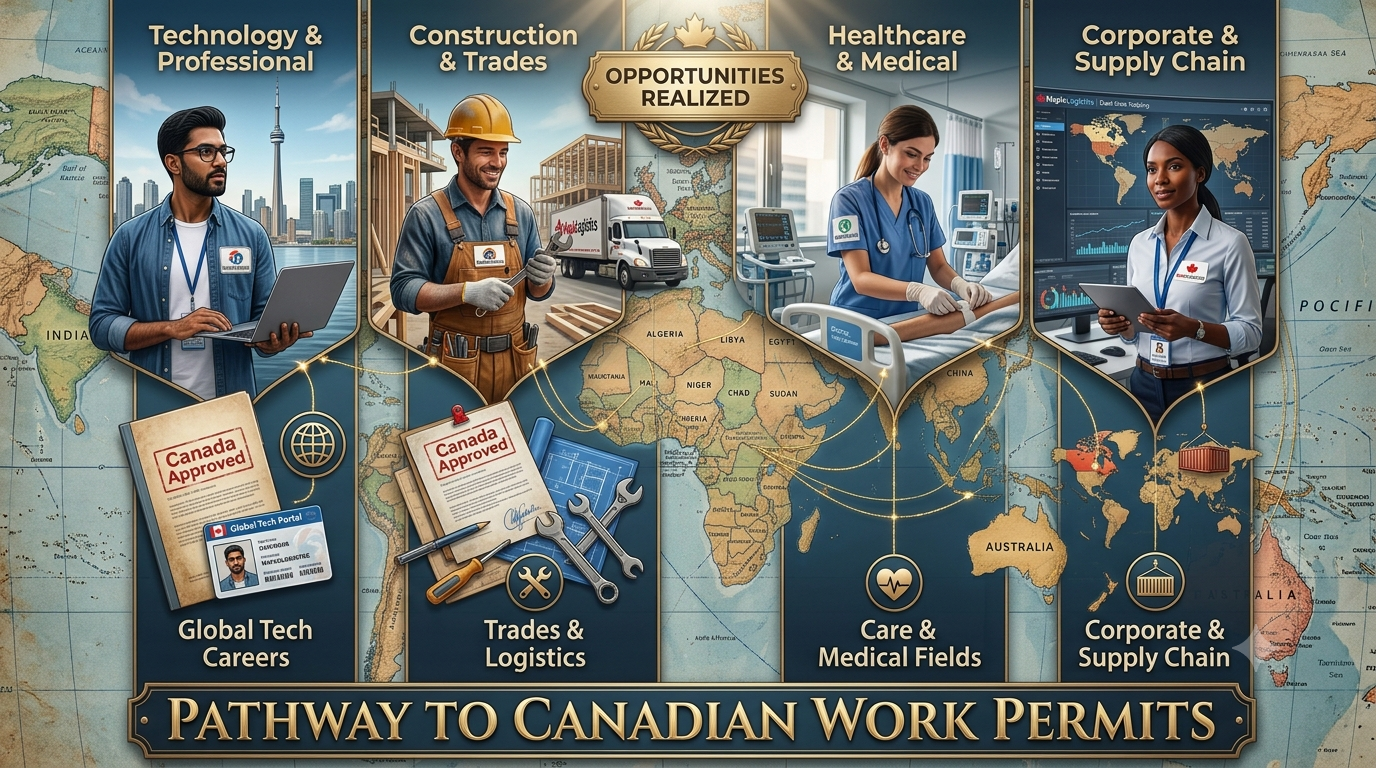
Which Industries Hire Foreign Workers in Canada?
Foreign-worker recruitment occurs across multiple industries.
The opportunities available to you will depend on your qualifications, occupation, location, and the employer’s labour needs.
Agriculture
Agriculture remains an important area of temporary foreign-worker recruitment.
Job Bank currently shows LMIA-related agricultural positions, including farm-worker roles. (Canada)
Examples include:
- General farm workers
- Fruit-picking workers
- Harvesting workers
- Livestock workers
- Agricultural labourers
Hospitality and Tourism
Hotels, restaurants and resorts can advertise positions involving foreign workers.
Examples include:
- Cooks
- Food service supervisors
- Restaurant managers
- Housekeepers
- Hotel workers
- Maintenance workers
Recent Job Bank results demonstrate LMIA-related activity in this sector. (Job Bank)
Food Processing
Food manufacturing and processing can also generate temporary foreign-worker opportunities.
Examples include:
- Food processing labourers
- Production workers
- Butchers
- Machine operators
- Supervisors
The July 2026 Job Bank listings included an LMIA-requested food-processing labourer position with Olymel. (Job Bank)
Healthcare
Healthcare employers can recruit internationally for certain occupations, particularly where qualified workers are needed.
However, regulated healthcare professions require additional attention to licensing and credential recognition.
For example, the recent Alberta Health Services physiotherapist listing illustrates that professional healthcare opportunities can appear in LMIA-related searches. (Job Bank)
Construction and Skilled Trades
Canada also has demand for workers in various construction and trade occupations.
Recent Job Bank results include LMIA-requested positions involving construction labour and skilled occupations. (Job Bank)
Examples include:
- Construction labourers
- Electricians
- Heavy-equipment operators
- Carpenters
- Maintenance workers
- Supervisors
For regulated trades, provincial certification requirements may apply.
Home Care and Support Services
Some Job Bank listings involve:
- Home support workers
- Personal aides
- Caregivers
- Child-care providers
Recent temporary foreign-worker listings included home support and child-care positions in several provinces. (Job Bank)
Applicants should carefully check whether the specific occupation falls under a program with additional eligibility requirements.
How to Find Companies Hiring Foreign Workers in Canada
You do not need to depend on random Facebook groups or websites claiming to have “guaranteed sponsorship.”
The safest approach is to begin with official Canadian resources.
Step 1: Search the Government of Canada’s Job Bank
Canada Job Bank – Temporary Foreign Workers
Job Bank has a dedicated search for employers seeking temporary foreign workers.
The site explains that these employers have already obtained or applied for an LMIA. (Job Bank)
You can search by:
- Occupation
- Province
- Location
- Employer
- Keywords
Step 2: Use the Foreign Candidates Section
This section is particularly useful if you are currently outside Canada.
Job Bank advises foreign candidates to:
- Confirm their eligibility.
- Check whether their qualifications are recognized.
- Search and apply for jobs.
(Job Bank)
Step 3: Search the Employer’s Career Page
After finding an employer, visit its official career website.
Do not immediately pay a third-party agent simply because someone claims to represent the company.
Compare the vacancy with the employer’s official recruitment information.
Step 4: Read the Job Description Carefully
Look for:
- Required education
- Work experience
- Language requirements
- Location
- Salary
- Working hours
- Job duties
- Certification requirements
- Application instructions
Do not apply for jobs simply because the title says “LMIA.”
You still need to qualify for the actual position.
Step 5: Prepare a Canadian-Style Resume
Your résumé should be:
- Easy to read
- Relevant to the job
- Accurate
- Tailored to the position
- Focused on achievements and skills
For most Canadian job applications, you should not include unnecessary personal information such as your age, marital status, religion, or passport number.
You can learn more about this in our related guide:
Canadian Resume Format Explained: How to Write a CV That Gets Interviews
Step 6: Apply Directly
Whenever possible, apply through:
- The employer’s official career page
- Canada’s Job Bank
- A verified recruitment channel
Be cautious about anyone demanding money in exchange for a guaranteed Canadian job or LMIA.
Does an Employer Have to Pay for an LMIA?
The employer generally bears the costs associated with the LMIA application.
The Government of Canada’s employer guidance explains that employers use LMIA Online to submit applications and must meet applicable program requirements. (Canada)
Applicants should therefore be extremely cautious if someone claims that they personally must purchase an LMIA from an employer or pay a stranger for an “LMIA certificate.”
A genuine immigration process involves specific government procedures and fees. It is not simply a matter of buying sponsorship.
Can an Employer Hire a Foreign Worker Without an LMIA?
Yes.
Not every Canadian work permit requires an LMIA.
Canada’s International Mobility Program includes categories in which employers can hire foreign workers without first obtaining an LMIA.
Examples can include certain workers covered by international agreements, intra-company transfers, and other LMIA-exempt categories, depending on the circumstances. (Canada)
The employer may still have to submit an offer of employment through the Employer Portal and pay the employer compliance fee where required. (Canada)
Therefore, “LMIA-exempt” does not mean “no immigration requirements.”
What Is an Employer-Specific Work Permit?
An employer-specific work permit allows a foreign national to work under specified conditions, which can include the employer, location, occupation and duration.
The Government of Canada states that an employer-specific work permit requires a job offer and that applicants must meet the applicable work-permit requirements. (Canada)
If you receive an employer-specific work permit, you cannot simply treat it like an unrestricted open work permit.
The conditions attached to your permit matter.
What Is an Open Work Permit?
An open work permit generally allows a person to work for most employers in Canada, subject to the conditions of the particular permit.
Unlike an employer-specific work permit, an open work permit does not normally require a specific job offer.
However, only certain foreign nationals qualify for open work permits.
The Government of Canada distinguishes between employer-specific and open work permits. (Canada)
Therefore, getting a job offer from a company is not automatically the same as getting an open work permit.
How the LMIA Process Generally Works
The basic process can be summarized as follows:
1. Employer identifies a labour need
The employer determines that it needs to fill a position.
2. Employer recruits workers
Depending on the LMIA stream and position, the employer must meet recruitment and advertising requirements.
3. Employer applies for an LMIA
The employer submits the required application and supporting documentation.
4. Government assesses the application
ESDC assesses whether the employer and position meet the applicable requirements.
5. Employer receives a decision
If the LMIA is positive, the employer can use it to support the applicable work-permit process.
6. Worker applies for a work permit
The foreign worker then submits the appropriate work-permit application and supporting documents.
This is an important point: the LMIA and work permit are separate steps.
Canada’s 2026 LMIA Environment
Canada’s temporary foreign-worker rules are not static.
In July 2026, the Government of Canada highlighted increased compliance measures under the Temporary Foreign Worker Program. For low-wage positions, employers must meet strengthened recruitment requirements, including advertising the position for eight consecutive weeks before submitting an LMIA application under the applicable rules. (Canada)
The government also emphasizes that the Temporary Foreign Worker Program is intended to address genuine labour shortages when qualified Canadian citizens or permanent residents are not available. (Canada)
This means applicants should not assume that employers can simply obtain an LMIA whenever they want.
The employer must satisfy the applicable requirements.
Can You Get a Canada Work Permit From Outside Canada?
In many cases, yes.
Most foreign nationals need a work permit to work in Canada, although exemptions exist.
The Government of Canada provides an application pathway for people applying for work permits from outside Canada. (Canada)
The appropriate process depends on your circumstances, the job, your nationality, the immigration program involved, and whether the position requires an LMIA.
What Documents Might You Need?
Depending on your situation, documents can include:
- Valid passport
- Job offer
- Employment contract
- LMIA decision letter, where applicable
- LMIA number
- Proof of qualifications
- Work experience evidence
- Educational documents
- Police certificates, where required
- Medical examination results, where required
- Proof of funds, where required
- Other documents requested by IRCC
The exact document requirements depend on the application.
Do not assume that every applicant needs the same documents.
You can learn more about this in our related guide:
Canada Visa Latest Updates 2026: Work Permit IRCC updates
How to Increase Your Chances of Getting an LMIA-Supported Job
There is no guaranteed formula, but you can improve your position by making yourself easier for employers to evaluate.
1. Target Jobs You Actually Qualify For
Do not apply for jobs simply because they mention LMIA.
If an employer requires three years of experience and you have none, your chances may be poor.
2. Focus on Provinces and Smaller Communities
Some labour shortages are more pronounced outside Canada’s largest metropolitan areas.
Job Bank listings demonstrate that LMIA-related opportunities occur in locations across different provinces, including smaller communities. (Job Bank)
Being open to relocating can expand your options.
3. Build Relevant Experience
If you are targeting skilled employment, relevant work experience can make your application more competitive.
For regulated occupations, obtain the required professional authorization where possible.
4. Improve Your English or French
Language requirements depend on the position.
Strong communication skills can improve your ability to compete for jobs and succeed in the workplace.
5. Obtain Relevant Certifications
Depending on the occupation, useful qualifications may include:
- Trade certifications
- Safety training
- Food safety training
- Healthcare credentials
- Equipment certifications
- Professional licenses
Always check whether a certificate is actually recognized or required for the job.
Beware of Canada Job Scams
The popularity of LMIA jobs has created an opportunity for scammers.
Be suspicious if someone promises:
- Guaranteed Canadian employment
- Guaranteed LMIA approval
- Guaranteed work permit
- Guaranteed permanent residence
- A job without an interview
- A fake employment contract
- A government “sponsorship certificate” that you must purchase
The Canadian government provides official information about temporary foreign workers, employers, work permits and immigration processes. Use these sources to verify claims. (Canada)
Never Assume a Company Will Sponsor You Because It Appears on a List
This is one of the most important warnings in this article.
A company can appear in:
- An LMIA employer dataset
- A Job Bank search
- An old job advertisement
- A news article
- A recruitment website
and still not be hiring foreign workers today.
Foreign-worker recruitment changes with:
- Labour demand
- Government rules
- Employer needs
- Location
- Occupation
- LMIA decisions
- Recruitment results
Always verify the current vacancy.
Are There Canada Visa Sponsorship Jobs With No Experience?
Some jobs may have relatively modest experience requirements, but “no experience” does not mean “anyone can get sponsored.”
For example, Job Bank has recently displayed LMIA-requested positions in areas such as:
- Food service
- Hospitality
- Agriculture
- Food processing
- Cleaning
- Home support
- Construction
(Job Bank)
However, each job has its own requirements.
A food counter position may have very different requirements from a healthcare or skilled-trades position.
Applicants should therefore search for specific occupations they can realistically qualify for, rather than searching only for “no experience sponsorship.”